Summary: This article explains why AI adoption in product design is not mainly a tooling problem, but a design distribution problem. It argues that AI creates the most value when organizations can turn local productivity gains into shared, governed, and scalable capability. The article explores five design distribution models: solo generalist, agency or elastic external support, product-dedicated distributed teams, centralized enablement, and hybrid orchestration. It explains how each model shapes AI adoption, knowledge transfer, design governance, quality standards, and long-term organizational capability. The core message is that AI does not automatically improve design maturity; it amplifies the structure it enters. Organizations that redesign how design capability is distributed, enabled, and governed will gain more lasting value than those that treat AI only as a toolset.

AI is changing product design, but the biggest challenge is not only AI tools or automation. It is how design capability is distributed, governed, and scaled across the organization. This essay explores how design distribution models shape AI adoption, design operations, governance, and long-term organizational capability in the AI era.
Most organizations still talk about AI in design as if it were mainly a tooling question.
Which model should we use?
Which tasks should we automate?
How much faster can designers work?
Those questions matter, but they are not the real strategic question.
The deeper issue is structural: what kind of design operating model allows AI to become more than local productivity? What kind of organization can turn AI from a personal advantage into shared, governed, and scalable capability? That is the central argument of my recent study on design distribution in the AI era.
The conclusion is simple:
AI in design is not mainly a tool problem. It is a distribution problem.
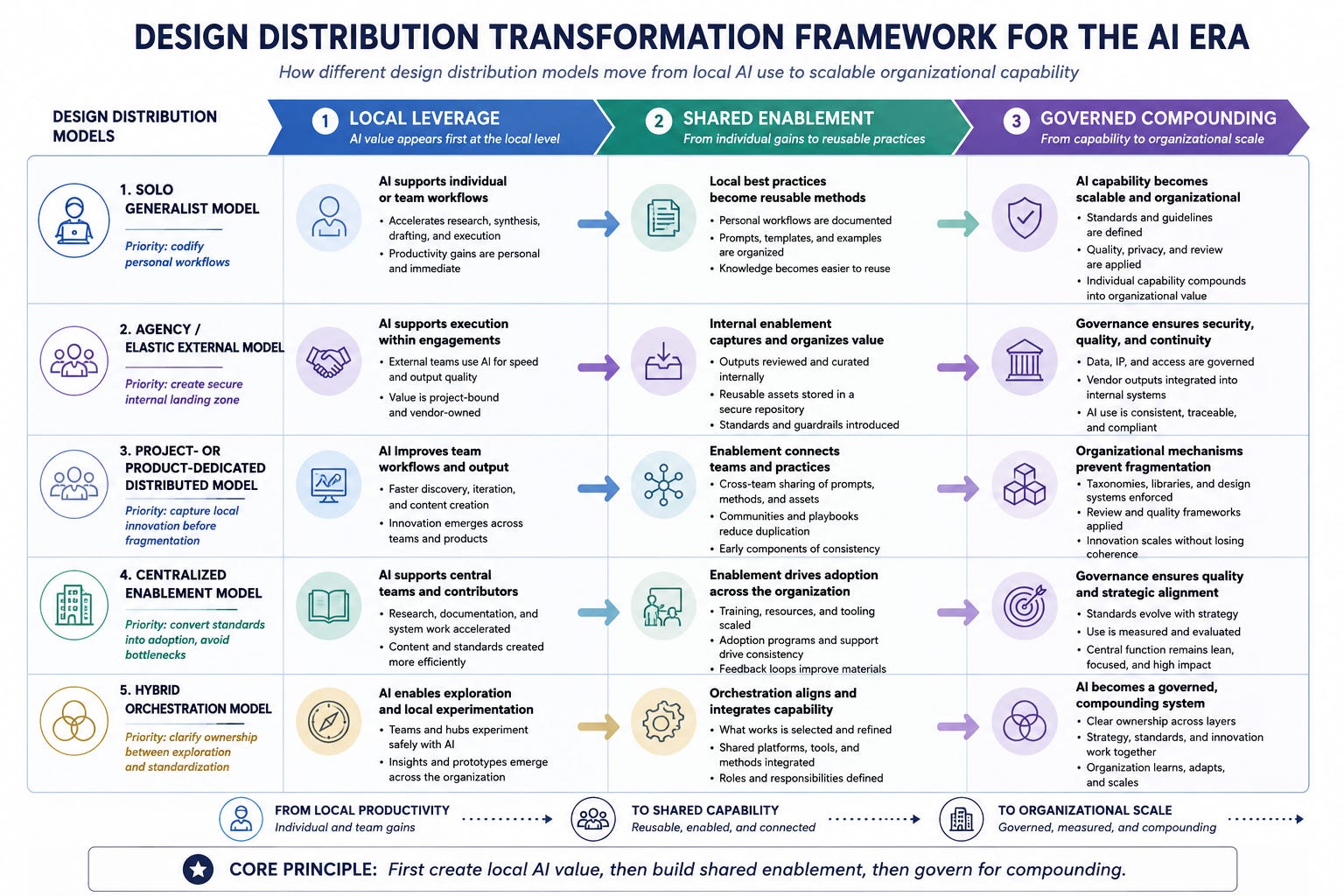
The organizations that create the most value will not simply be the ones that use AI more often. They will be the ones that redesign how design capability is distributed, governed, and scaled.
The misunderstanding at the center of the AI conversation
AI is often treated as a universal accelerator. In product design, that assumption is especially tempting because the local gains are already visible.
Research synthesis can be accelerated.
Documentation can be drafted more quickly.
Wireframing, ideation, prototyping, QA support, and parts of design-system work can all be supported in ways that were not practical before.
So it is easy to assume that if designers have better AI tools, the organization will naturally become better at design.
But that is not how organizational change works.
AI does not repair weak structure. It amplifies the structure it enters.
If design maturity is low, AI may simply produce faster weak decisions.
If standards are unclear, AI may multiply inconsistency.
If knowledge is trapped inside individuals or teams, AI may improve local performance without creating shared capability.
If governance is absent, AI may create speed without trust.
That is why some companies will get quick wins from AI and still fail to create lasting advantage. They are improving execution without redesigning the system around execution.
The real variable: design distribution
Design work never happens in isolation. It always happens inside some kind of operating environment.
Sometimes design is centered in a single strong generalist.
Sometimes it is externalized through agencies, consultants, or elastic freelance support.
Sometimes it is embedded directly into product teams.
Sometimes it is supported by a centralized hub or DesignOps function.
And sometimes it sits inside a hybrid system that combines local autonomy with central coordination.
These models are not just reporting structures. They shape how design knowledge travels, how standards are maintained, how quality is governed, and how learning compounds.
That is why they matter so much in the AI era.
The same AI tool will produce different organizational outcomes depending on where design capability sits and how the organization moves knowledge across teams. In one environment, AI becomes a fast local workflow aid. In another, it becomes a reusable operating pattern. In another, it becomes a governance problem. And in the strongest environments, it becomes part of structural advantage.
The five design distribution models
To make this easier to reason about, I grouped design environments into five practical models.
1. Solo Generalist Model
This is the simplest structure: one strong designer, or a very small design function operating with high individual ownership and low formal coordination.
In the AI era, this model often moves fast first. A capable generalist can create immediate gains by building personal workflows, accelerating synthesis, and using AI to reduce operational overhead.
But the limitation is obvious: value stays trapped inside one person unless it is codified.
The first transformation priority here is not large-scale governance. It is codification. Personal methods have to become templates, checklists, prompts, and decision rules before they can be reused.
2. Agency / Elastic External Model
Here, design capability is extended through vendors, agencies, consultants, or flexible contributors. Organizations often like this model because it optimizes cost and capacity.
AI can make these external contributors even more effective. But it also sharpens a structural tension.
The company wants:
- strong output
- fast delivery
- access to specialized expertise
At the same time, it also wants:
- secure tool usage
- protected data
- controlled workflows
- internal ownership of standards
That creates a recurring tension between protecting the system and preserving high-performance flexibility.
This is why the main transformation priority in this model is creating a secure internal landing zone for externally enabled output. Otherwise, the vendor becomes more capable, but the company itself does not become more intelligent.
3. Project- or Product-Dedicated Distributed Model
In this model, designers are embedded in product or project teams, with strong local context and relatively weak central design structure.
This is one of the strongest models for early AI experimentation because teams are close to real delivery work. They can test ideas in context, iterate quickly, and integrate AI into actual workflows rather than abstract pilot programs.
But this is also where fragmentation appears fastest.
Prompts vary. Methods diverge. Teams build different habits. Useful local breakthroughs do not automatically become reusable capability elsewhere.
The transformation priority here is capture before fragmentation. The organization needs a way to extract and connect what works across teams before the local advantage turns into structural inconsistency.
4. Centralized Enablement Model
In this model, design capability is supported through a central function such as a design hub, design systems team, or DesignOps-led structure.
This model is often underestimated in AI conversations because it does not always look like the place where experimentation starts. But it is often the place where AI can become durable.
Why? Because this is where organizations can build:
- shared standards
- approved tool logic
- reusable templates
- documentation
- evaluation rubrics
- training patterns
- governance mechanisms
In other words, this is where AI can stop being personal and start becoming organizational.
The danger, of course, is over-centralization. If the center turns into an approval bottleneck, experimentation slows and value stalls.
The transformation priority here is clear: convert standards into adoption without turning governance into friction.
5. Hybrid Orchestration Model
This is the most complex and, in many ways, the most promising structure.
Here, local teams retain contextual ownership, while a broader design function provides coordination, standards, and enablement. Done well, this model allows two kinds of intelligence to coexist:
- local learning through real experimentation
- centralized compounding through shared operating logic
This is where mature AI transformation becomes possible.
But hybrid only works when ownership is explicit. If local teams own experimentation but nobody owns consolidation, knowledge fragments. If the center owns standards but not adoption, assets remain unused.
The main transformation priority here is clarity of ownership between exploration, standardization, and evaluation.
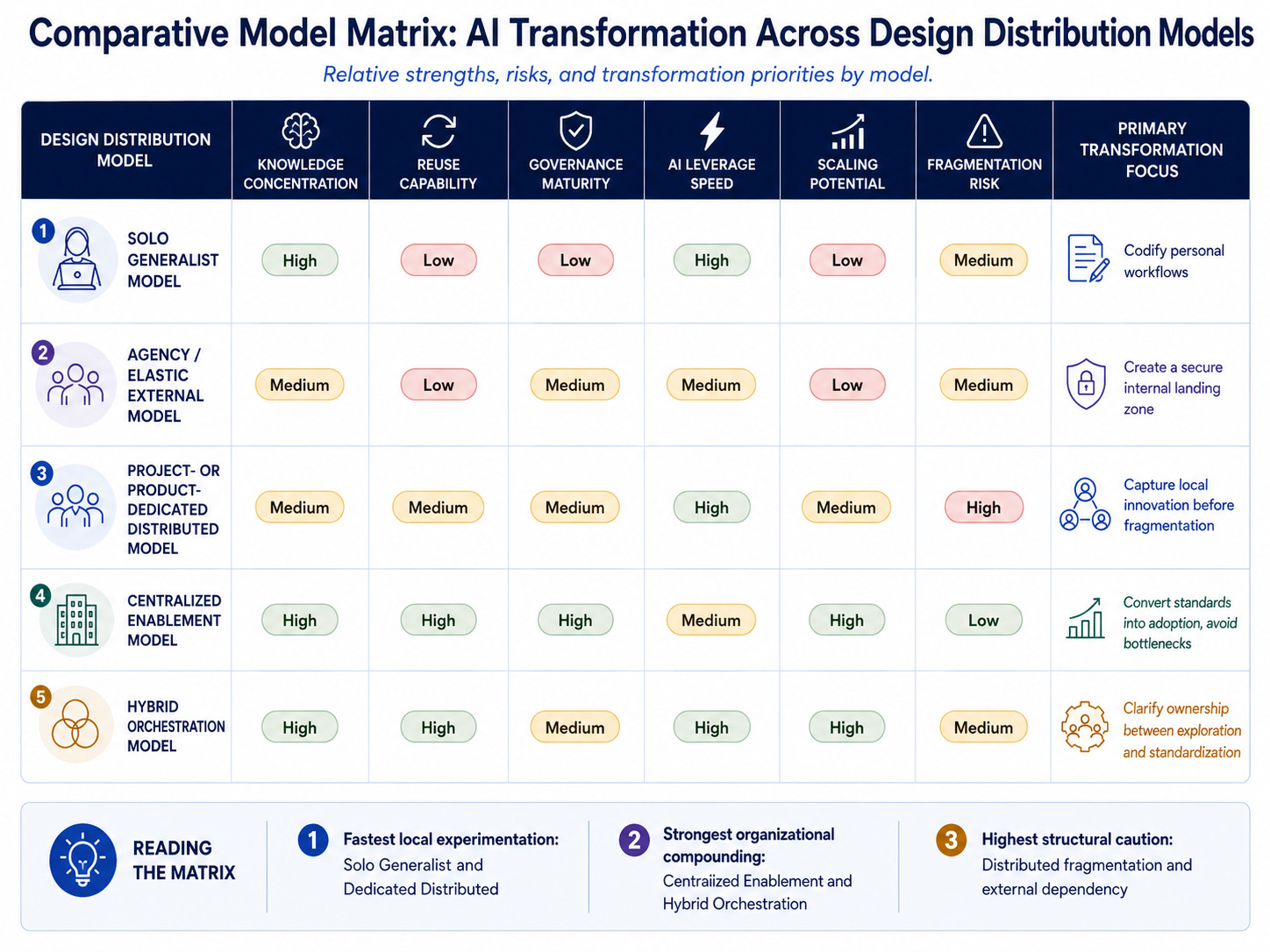
What the evidence already points to
Even though comparative evidence is still incomplete, the current picture is already clear enough to support a few strong conclusions. The study’s empirical layer shows three patterns especially well: AI value appears first locally, coordination determines whether it scales, and enablement matters disproportionately.
First: early AI use is mostly local
The strongest pattern is that AI adoption in design starts at the level of the individual practitioner or the local team.
People use it for:
- synthesis
- drafting
- ideation
- workflow acceleration
- review support
But formal team-level operating models and organization-wide standards are still much less common.
That means local value is appearing before organizational structure catches up.
Second: coordination determines whether local gains scale
AI can create fast value in context-rich work. But scaling that value depends on coordination.
Without explicit coordination, organizations run into:
- review burden
- trust problems
- uneven quality
- unclear ownership
- duplicated methods
- fragmented practices
So the problem is not just tool access. It is whether the organization can coordinate around ambiguity.
Third: enablement matters more than most teams think
The organizations best positioned to compound AI value are not necessarily the ones with the most experimentation. They are the ones with stronger mechanisms for:
- documentation
- standardization
- shared repositories
- method transfer
- training
- governance
AI does not scale through adoption alone. It scales through enablement.
Fourth: judgment becomes more important, not less
As more execution-support tasks become easier to accelerate, the designer’s differentiating role shifts further toward:
- framing
- synthesis
- prioritization
- systems thinking
- strategic interpretation
- product judgment
That is why AI does not reduce the need for strong design leadership. It increases the premium on it.
The real challenge is not adoption. It is compounding.
This is the distinction I keep coming back to.
Many teams can use AI to improve execution.
Far fewer can convert that improvement into a stronger operating model.
That is the real dividing line.
Because there is a big difference between:
- a designer getting faster
- a team building a good habit
- and an organization building a repeatable capability
That is the maturity curve that matters.
Not:
more AI usage
But:
individual leverage → team-level optimization → organizationally governed capability
If that shift does not happen, AI remains local.
Useful, yes.
Impressive, maybe.
But not strategically transformative.
A practical way to think about scaling AI in design
The framework I find most useful is simple. AI value in design scales in three layers: local leverage, shared enablement, and governed compounding.
1. Local leverage
This is where AI creates its first value.
A designer or team uses AI to improve speed, reduce friction, or strengthen output in real work.
At this stage, the goal is not broad standardization. The goal is to identify where value is genuinely emerging.
2. Shared enablement
Once useful local patterns appear repeatedly, the organization captures them.
This is where good practice becomes:
- reusable
- documented
- teachable
- reviewable
- transferable
This is the bridge between local experimentation and organizational capability.
3. Governed compounding
At this stage, AI becomes part of the design operating model.
Ownership is defined.
Evaluation is clearer.
Governance exists.
Standards can evolve without crushing experimentation.
Learning is retained over time.
This is where AI starts to create structural advantage.
The principle is simple:
First create local AI value, then build shared enablement, then govern for compounding.
What leaders should do differently
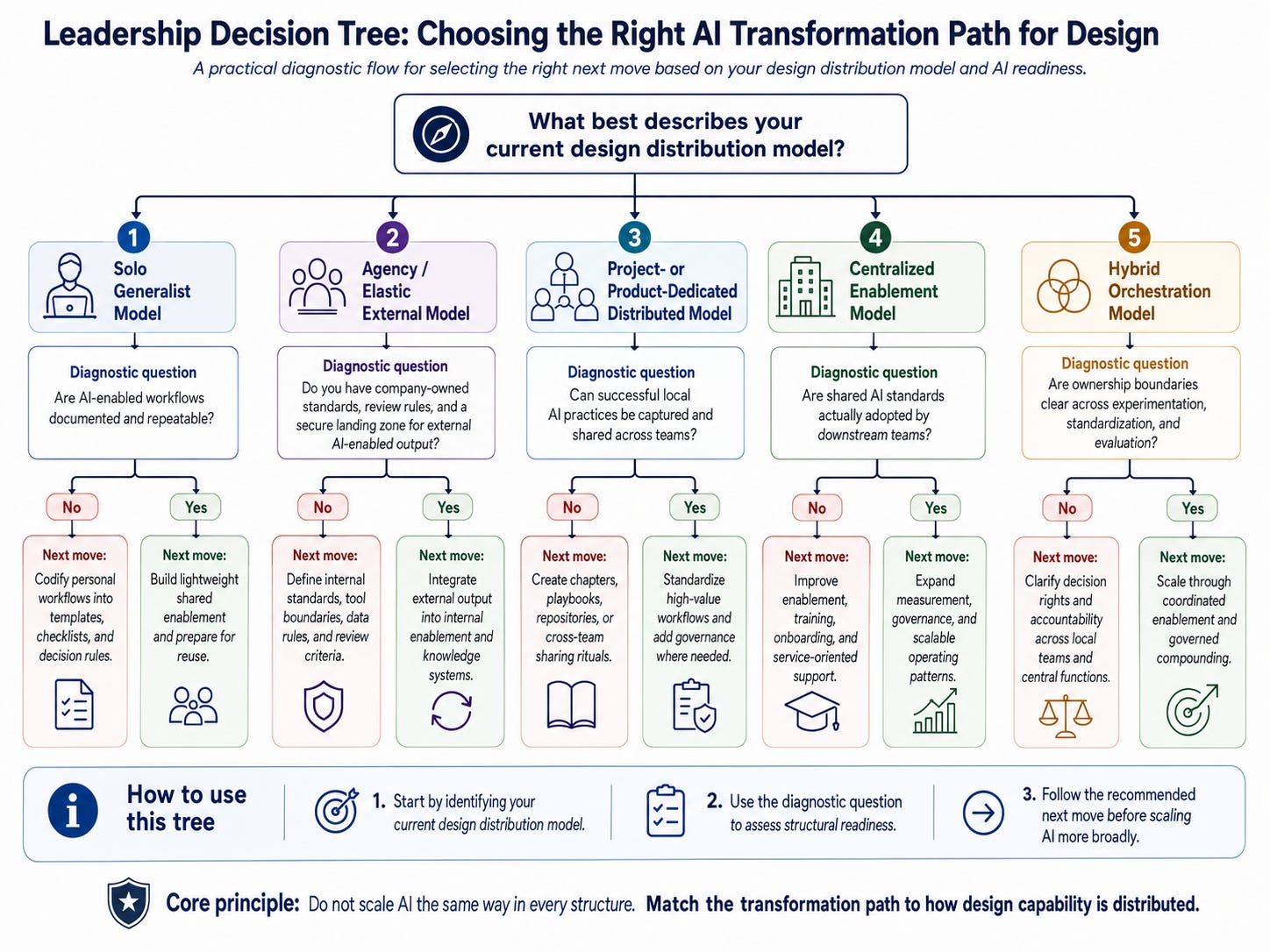
If you lead design, product, or transformation work, the most important shift is to stop treating AI as a parallel tooling program.
Instead, ask:
- Where does design knowledge currently live?
- What should remain local?
- What should become standardized?
- Who owns enablement?
- Who owns evaluation?
- How will good local practices travel across teams?
Those are not implementation details. They are strategic questions.
Because they determine whether AI becomes:
- a productivity layer
or - an operating capability
The mistake to avoid
The most common mistake is probably this:
Organizations see strong local wins and assume transformation is already happening.
A few capable people get faster. A team builds an effective workflow. A tool starts to look promising.
And the organization interprets that as maturity.
But local success can be misleading.
Without reuse, it stays personal.
Without enablement, it stays fragmented.
Without governance, it stays risky.
Without evaluation, it stays ambiguous.
That is why some organizations will look fast in the short term and still underperform in the long term.
They are scaling activity, not capability.
The bigger point
AI is changing design work. That much is already clear.
But the deepest subject is not AI itself.
The deeper subject is organizational choice.
What kind of design structure do we want?
What kind of intelligence do we want to build?
How should design capability move through the organization?
What should be protected, shared, standardized, and scaled?
Those questions matter more than the next feature release or the next model upgrade.
Because AI changes the pressure.
Design distribution determines the outcome.
Further Reading
PDF version of the full study: [Download]
Full study on my website: [Read Full Study]
Connect with me: [Linkedin]